
How to plan and conduct internal audits: programme, plan, findings and report
TürkçeEnglish
A practical guide to ISO 9001 clause 9.2: the annual audit programme, auditor independence, checklists, types of findings and moving from report to corrective action.
An internal audit is not a rehearsal for the certification audit; it is how you see for yourself whether your management system works. A well-planned programme reveals what you should find before the external auditor does.
Start with an annual programme
The programme shows which processes are audited, how often and in what order. Base priorities on the importance of each process, previous audit results, customer complaints and recent changes. Every process can be covered at least once a year, problem areas more often.
Auditor independence
Auditors should not audit their own work. In small companies cross-audits (purchasing audits production and vice versa) or external support can solve this.
Plan and checklist
For each audit, write down the scope, criteria (relevant clauses and procedures), date and team. A checklist is a guide and should be used flexibly. Ask “how do you do this, can you show me?” rather than “do you have…?”.
Types of findings
- Nonconformity: objective evidence that a requirement is not met
- Observation: not yet a nonconformity but a risk
- Opportunity for improvement: works, but could be done better
Each finding needs a clear criterion (which clause or procedure) and evidence (record number, observation, interview). Findings without evidence start arguments; findings with evidence start improvement.
Report and corrective action
The report summarises the audit and lists the findings; once finalised, findings should not be changed. Nonconformities lead to corrective actions with owners. Observations and opportunities should also be followed up, at least as input to the management review.
Internal audits in QMOS
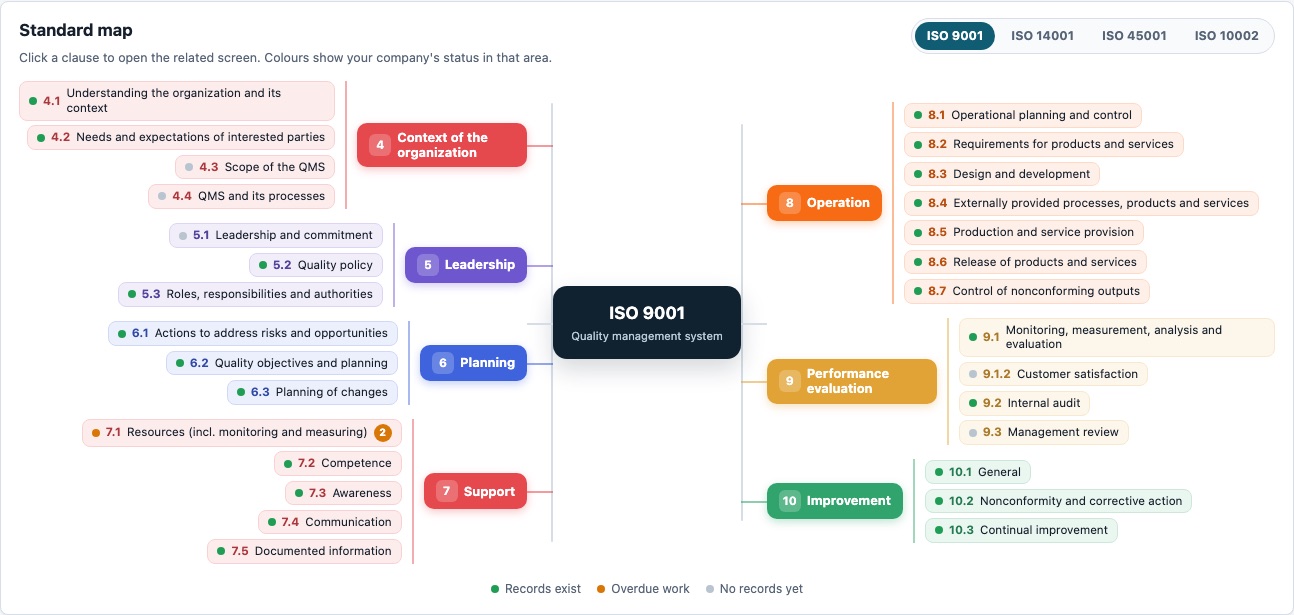
QMOS manages the annual programme and audit plans and warns when an auditor is assigned to their own process. Findings are recorded on site, frozen when the report is finalised, and a corrective action can be opened from a nonconformity with one click. On the standard map, clause 9.2 takes you straight to the audit screen.
Sık sorulan sorular
Do internal auditors need a certificate?
The standard does not require a specific certificate; auditors must be competent and you must be able to show it. Training and experience records provide that evidence.
Must every clause be audited every year?
The programme is risk-based; the aim is to cover all requirements within the certification cycle.