
Integrated management system: running ISO 9001, 14001 and 45001 as one
TürkçeEnglish
How the common high-level structure lets you run quality, environmental and OH&S management with one set of documents, one audit programme and one management review.
Building three separate systems for quality, environment and occupational health and safety means three document sets, three audit programmes and three management meetings. Because ISO management system standards share a common high-level structure, they can be brought under one roof.
What the common structure gives you
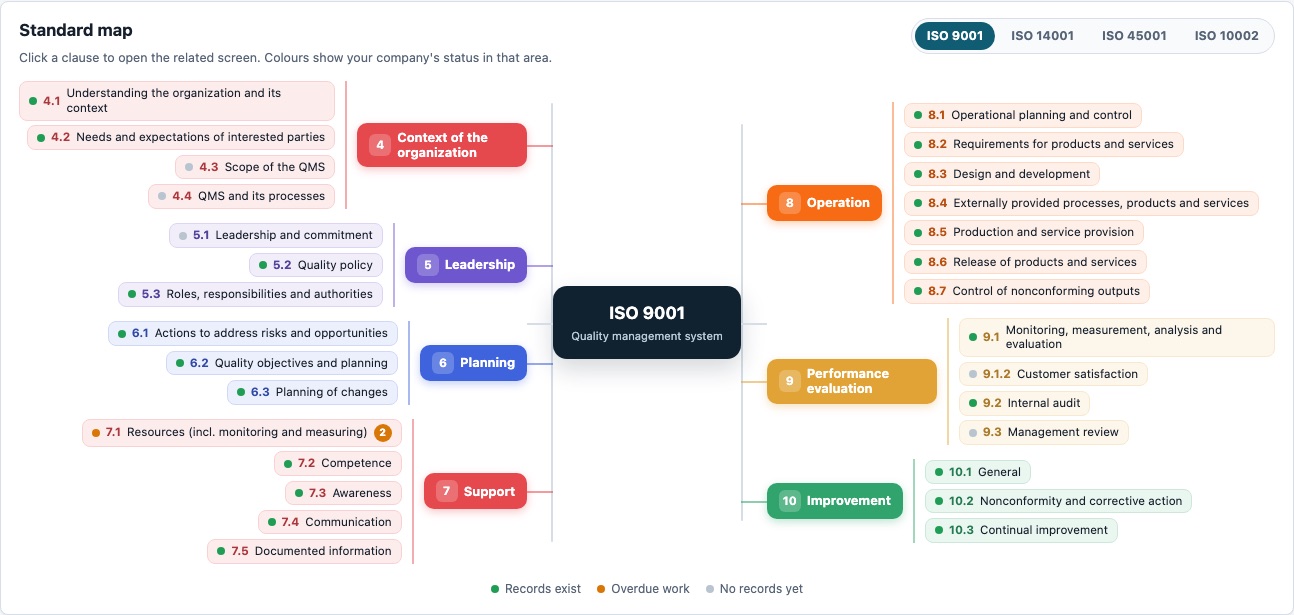
ISO 9001, 14001 and 45001 use the same main clause layout: context, leadership, planning, support, operation, performance evaluation and improvement. Document control, competence, internal audit, management review and corrective action can therefore be run jointly for all three.
What is shared and what is specific
- Shared: document control, training and competence, internal audit, management review, corrective action, change management
- Environment-specific: environmental aspects and impacts, compliance obligations, environmental indicators
- OH&S-specific: hazard identification and risk assessment, worker consultation and participation, incident and near-miss management, contractors
Tips for the transition
- Merge shared processes into one procedure and add discipline-specific requirements as sections.
- Prepare one internal audit programme and state in each plan which standards are covered.
- Hold one management review with inputs per standard.
- Use a common method language for risk assessments, but keep specific criteria for environment and OH&S.
Points to watch
Integration must not mean ignoring discipline-specific requirements. Worker participation and incident investigation in OH&S, and compliance evaluation in environmental management, need their own rigour. Certification bodies can perform integrated audits, which usually saves time and cost.
Integrated systems in QMOS
In QMOS standards are added as modules; shared screens (documents, corrective actions, audits, management review, training) serve all standards, and discipline-specific screens appear with the relevant module. An audit plan can cover several standards, and the standard map shows the status of the clauses of each standard in its own tab.
Sık sorulan sorular
Do we need to adopt all standards at once?
No. Starting with one standard and adding others later is common; the shared structure makes this easier.
Is a single manual enough?
The standards do not require a manual, but one guiding document describing the scope and process interactions of the integrated system is useful.