
Corrective action (CAPA) step by step: from root cause to effectiveness review
TürkçeEnglish
A practical walk-through of nonconformity and corrective action (ISO 9001 clause 10.2): containment, root cause analysis, action plan and effectiveness review.
Corrective action records are the clearest evidence of whether a management system actually learns. Yet in many companies a CAPA is just a form closed with “issue fixed”. This article walks through the path from a nonconformity to a lasting solution.
1. Describe the nonconformity precisely
A good description answers what, where, when and how many. Instead of “product faulty”, write “edge burrs on 120 bracket parts produced on line 2 during the 22 September shift”. Record the source as well: internal finding, customer complaint, audit finding, supplier or calibration result.
2. Contain immediately
Root cause analysis takes time; meanwhile you must stop defective products reaching the customer. Segregating stock, 100% inspection or informing the customer are containment actions. Containment is not the permanent fix and should be recorded separately.
3. Find the root cause
5 Whys and the fishbone (Ishikawa) diagram are the most common methods. Question the system, not the person. “The operator was careless” is rarely a root cause; “the tool change interval is not defined in the maintenance plan” is a system gap that can be fixed permanently.
- Why were there burrs? → The cutting blade was worn.
- Why was it worn? → The change was overdue.
- Why overdue? → The interval was not in the maintenance plan.
- Why not? → The plan was not updated when the die was introduced.
4. Plan the actions
Each action needs an owner and a due date, and should target the root cause: adding blade changes to the maintenance plan, adding a burr check to the final inspection list. Also ask whether similar processes carry the same risk.
5. Review effectiveness
A CAPA is not closed just because the actions are done. After a defined period, check whether the problem has recurred, for example no repeat for six weeks. Having someone other than the action owner judge effectiveness improves objectivity.
6. Close and learn
An effective CAPA is closed; an ineffective one is reopened with a new root cause analysis. Closed CAPAs feed the management review and update the risk assessment.
CAPA in QMOS
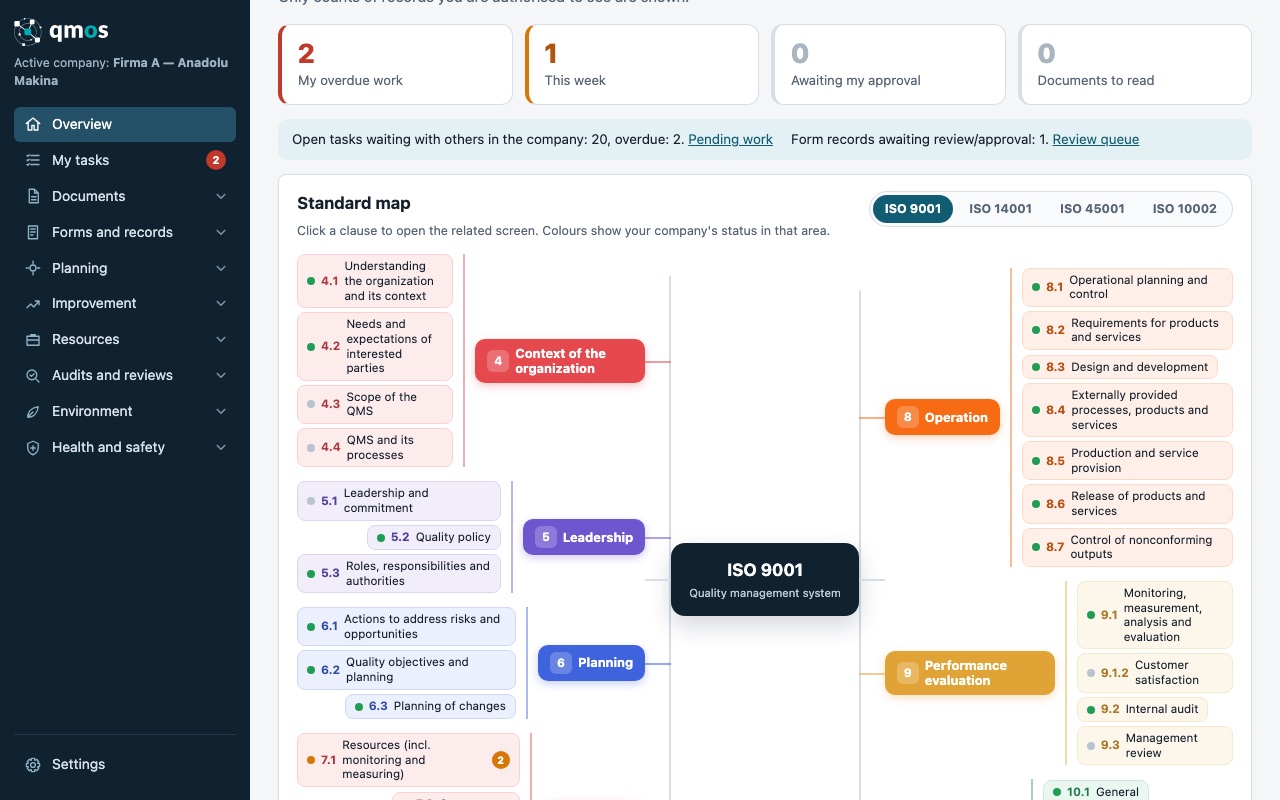
In QMOS a nonconformity moves through containment, root cause, actions and effectiveness review. Actions become tasks for their owners with reminders before the due date; the effectiveness decision is confirmed with a password and kept in the audit trail. CAPAs can be opened directly from an audit finding or a calibration deviation.
Sık sorulan sorular
What is the difference between containment and corrective action?
Containment limits the impact immediately; corrective action removes the root cause so the problem does not recur.
When should effectiveness be reviewed?
After enough time has passed to see whether the problem recurs; set the period according to the size of the risk.